"Down with the Empire": No More Death Stars is ready for a California Funeral
No More Death Stars talk Beach Boys, punk, and their new record. "I just want to make rad records that people have a real response to, and I need just enough money to do that, that's all I need."
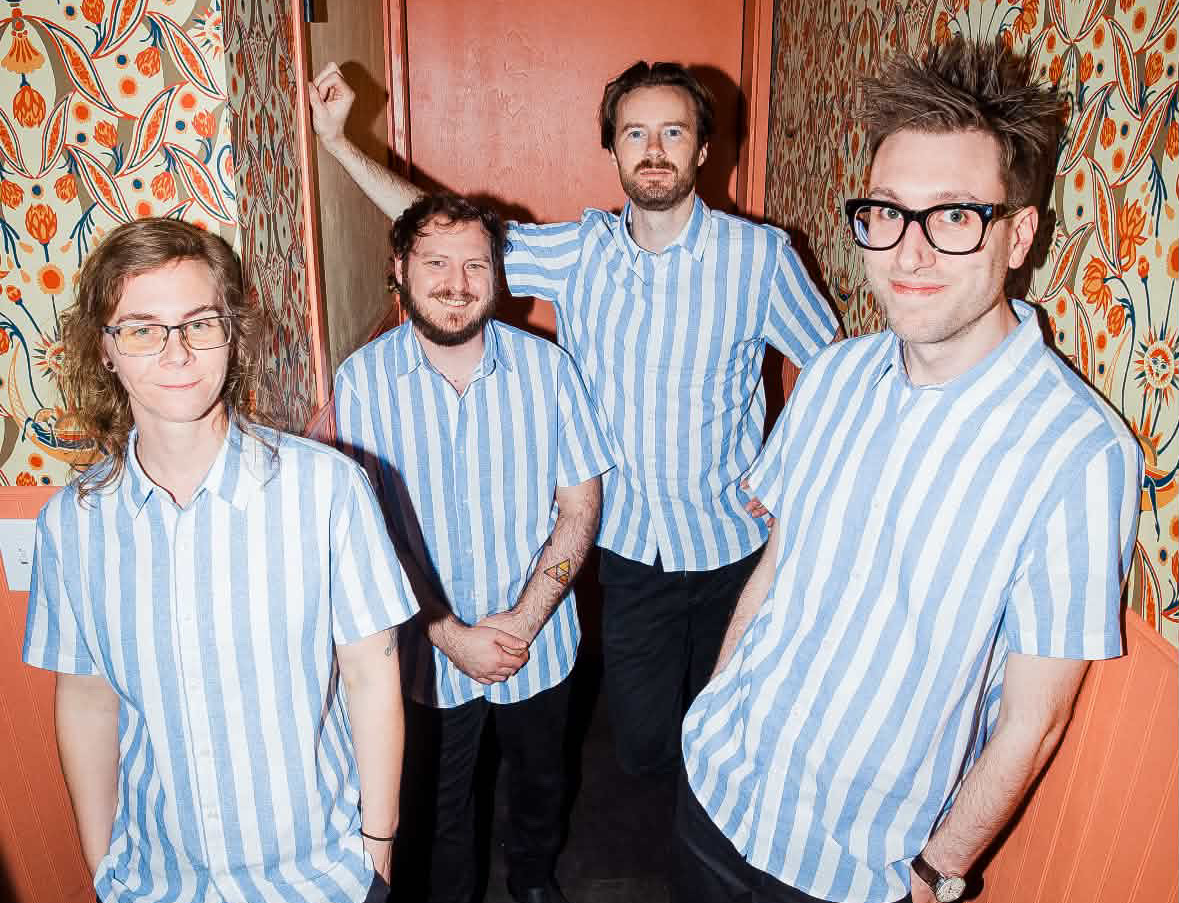
The four members of No More Death Stars are all piled into a car "for the audio quality." In an inversion of the usual arrangement, the backline is in the front seats — bassist and lead vocalist Kevin Cardinale in the driver's seat, drummer James Drake in the passenger seat, while guitarists Amber Lombardy (who is seven months pregnant) and Mark Hardee sit in the back.
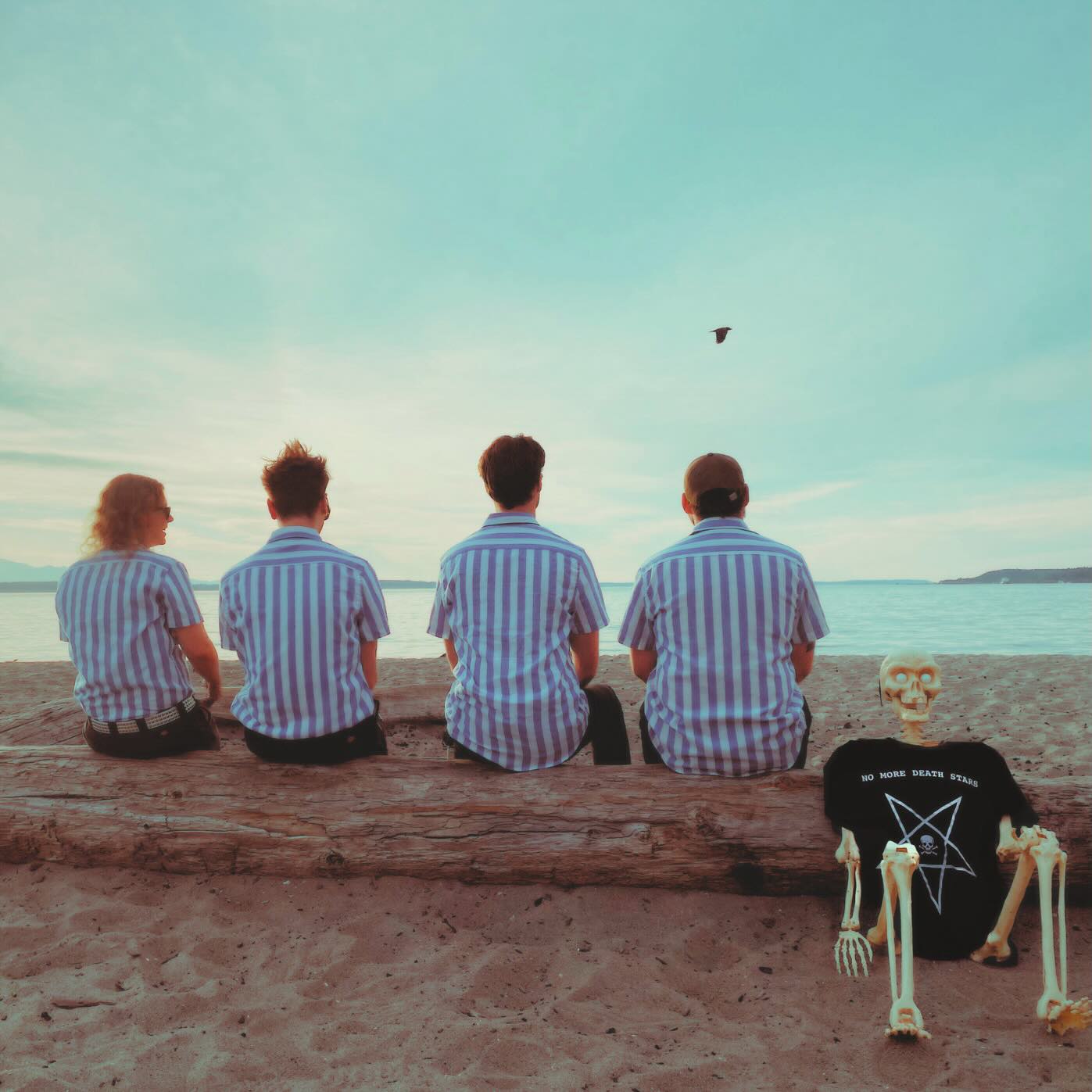
Ostensibly a project of Kevin's, he assembled the current lineup after relocating to Seattle from New York four years ago. Their second album, California Funeral, a surf-punk/skate-punk full-length that owes as much to the Beach Boys as it does to Blink-182, comes out September 4. The band is playing their album release party that night at the Black Lodge with support from Hetakuso and Picket Line.
We talked about how the Beach Boys influenced the new record, what it's like to collaborate together on writing songs, the Seattle music scene, and potential name options for Amber's forthcoming baby.
(This interview has been edited for flow and because, like, uh, the interviewer, like, says "like" like a lot.)
Deedub: Can we just go around — a who's who? A roll call?
Kevin: A roll call, please. Hello, I'm Kevin. I play bass and sing, and I try my best to write songs.
James: I'm James, and I play drums and sometimes scream in the background.
Mark: Hey, Mark. I play guitar and yell in the background. I've been in the band for three and a half years now.
James: We all have.
Amber: I'm Amber. I play guitar.
James: And you scream sometimes.
Kevin: I think everyone's screaming a little bit.
Deedub: It's not like you all are doing easy listening music.
Kevin: That's our next record.
Deedub: So, tell me about yourselves — how you all got together.
Kevin: Well, I've been doing the band — these guys have all been here for three and a half years, but I've been doing this band for about 10 years. I started it in New York, where I grew up. It was always a bit of a revolving door of people — my way of escaping bands constantly breaking up, because people's lives change. It was a revolving door for the longest time.
I moved out here about four years ago, met these guys, started playing together, and taught them the last record we'd done. And then very quickly we came up with the stuff that's on the new record. Does anyone want to add to that? They're probably better orators than me.
James: You met via Craigslist.
Kevin: Well, I met Mark and Amber on Craigslist, and it was so weird. I put my fully fledged record that has come out — I linked it and everything — and I thought for sure this was going to get some bites, because I have a proof of concept here.
I only got two responses, and it was these two dorks. And then James — we acquired through Mark, because you guys were in another band together.
Mark said to me, "I know a drummer I can ask to play with us, but it's going to break up our other band that we're already in. And because he has the practice space, it's also going to mean that the other people in that band can't practice anymore." So I very much — how old-timey prospectors, when they kill each other in the desert with a big rock —I did that to this other band. Unfortunately. Sorry, other band. And now we're just the best of friends.
Deedub: Of course. Sometimes I wonder with bands if they needed divorce attorneys for all these sort of things.
Kevin: You kind of do. So I'm lawyered up — I don't know about these guys.
Deedub: I was looking at your influences for this record, and you listed Surf's Up, and you don't hear the Beach Boys associated a lot with punk or hardcore. Talk to me about the Beach Boys.
Kevin: I'm a huge Beach Boys fan. I think the DNA of pop punk and skate punk owes a lot to the Beach Boys, because if you think about it, the Beach Boys were these young dudes from Southern California who were writing super catchy songs that were, behind all that, actually pretty emotionally weighty. But on the surface they were seemingly just songs about liking girls and doing board sports with your buddies.
So I think in a lot of ways, I don't think something like Blink-182 would really ever happen with the Beach Boys. They're in a lot of ways just millennial Beach Boys without the insane level of musicianship that the Beach Boys have. Nothing against Blink, but I don't know — I just always really like cinematic records with a large scope.
I feel like I've always, since I've been doing this band, been trying to figure out how do I bridge the gap between Fugazi, but also I like Radiohead — what's that in-between space? I love the Beach Boys. They're probably my favorite band if I had to declare something with a gun to my head.
But I just love the Beach Boys. On a thematic level, if you think about Brian Wilson, they're very punk rock, but Brian Wilson is also kind of an early emo dude — this guy who hangs out in bed all day and can't handle the fame and is completely awkward, but just writes these bangers.
Deedub: It's always fun to listen to that because it's — this is such lovely, amazing pop music that's orchestral. He called [the never-released album] Smile "teenage symphonies to God."
Kevin: Yeah.
Deedub: And then you dig into their lyrics and it's very much: life is horrible, and we're all going to die.
Kevin: It's funny. I think that's another thing they have in common with a lot of the more bubblegum punk — it's just kind of a way of forcing happiness, where these are happy songs written by not very happy people.
Deedub: For sure. It's almost the reverse there for him. It's interesting to hear Surf's Up — I don't hear people talk about them post-Pet Sounds, post-Smile.
Kevin: It's a shame. I think that's a really fascinating era of the band.
I think that's because it's funny that everyone thinks of them as this happy-go-lucky beach band when they have one of the darkest band bios in all of rock music. I think the early '70s is where more of the fallout of all that — the fallout of the mental breakdown, the fallout of the Charles Manson thing. All those things kind of came to a head, and you end up with this record that's kind of like their Pinkerton or something.
It's the dark, depressing Beach Boys record that they recorded entirely in Brian Wilson's living room, at a point where he wasn't really interested in participating in anything. And the story I always heard is he would hang out upstairs, sleep all day, go to the bathroom, and the band would record what they thought was the album without him, and then he would come down at night and record a whole song — every instrument — that didn't exist at the start of that day, and they would come back the next day and those were the songs that ended up being on the record.
And then all the songs are just about dying and losing your way with your artistic gifts and being kind of — I don't know — feeling obsolete to the world, all these things that I was feeling when I wrote this record. So it kind of became a huge influence, for sure, that record particularly.
And also, it's when the Beach Boys sort of went back to being a rock band after doing these huge symphonies you mentioned. And the last record I did with this band was so involved — I recorded it during the pandemic, and I really thought, we're never going to have to do this live, so it doesn't matter. I just threw everything into it. And at the end of that, I was really tired.
It makes you understand why he had to spend all those years in bed, because making a record like this is so exhausting.
Deedub: Clinical depression and acid are a hell of a drug.
Kevin: Hell of a combo. Mark does that, actually. That's Mark — macro-dosing.
Deedub: If you live in Seattle, you have to be microdosing depression all the time, right?
Kevin: I'm not microdosing yet, but maybe after this interview, I will be.
Deedub: So, this new album as this four-piece — how did the process of writing and recording go? What lessons are you all taking away from that experience?
Kevin: Anyone else want to answer that? I'm curious to hear from someone who's not me.
Mark: Amber and I — well, usually we would get a video on a cell phone, Kevin, with an acoustic guitar, and he just outlines the songs that way. So we'd get that a couple of days before band practice. We can get some ideas in our heads, and we plug into our amps, and it sounds very much the same even though it's so bare-bones. And then we have free rein to kind of figure the song out as a band.
We're very supportive of each other. It's been really nice to have ideas come to you and get to add your own twist to it. So it's been a very cool process to start taking shape for me.
Kevin: I learned very early on that this lineup is really special. The four of us connect musically in a really nice way. Probably the first or second song we really worked on as a group, I figured out pretty quickly that I need to forget what I thought the song was going to sound like when I wrote it, and allow us to lean into our natural inclinations and dynamics.
Our last record, I wrote just about everything top to bottom, and then I let people add their stamp on it, but there was a bit more of me showing people specific riffs to play and implanting ideas. Whereas now I might write a song and intend it to be kind of an up-tempo, catchier pop song, and it just turns out it might be a wall of doom of really slow BPM. And it just felt like — I don't know — you end up with cool evil twin versions of songs that way. So I just kind of try and stay at a distance more so lately.
James: Having a bass player be the singer-songwriter of the group, drumming-wise, I get minimal notes, mainly because I'm just ripping off what Kevin is doing, or Amber or Mark, in the moment. I'm very much a play-to-the-band drummer, so they make my job incredibly easy, because all I'm doing is stealing what they're doing and putting it in drum format. It's been the least stressful and least demanding mentally to come up with drum parts, or be restricted, because I don't feel restricted — like they said, we all kind of just click.
So it's minimal thinking, and really just being in the moment and letting the song write itself. At least for me, that's what it feels like.
Kevin: I'm stressed out the whole time.
James: That's your bass line now.
Kevin: That's my normal.
Deedub: Sounds like the bass is pulling the drums along, and the guitars are just along for the ride.
Kevin: I feel like James, and I do a lot of interplay. I kind of think of what he's doing on drums as — each piece of the drum set is kind of like a different string, or section, of the bass neck or spectrum.
If he's going really heavy on a kick drum, that's kind of my cue to hit some root notes and make it feel deep and full. And I think the two instruments together — that's a lesson learned from stuff like Pet Sounds, too — is how you can take multiple sounds and together they become kind of one sound.
Deedub: Sort of symphonic idea of music. It was interesting hearing your album, because it all feels like it fits together symphonically. It doesn't feel like anybody's necessarily leading, but everybody's marching with each other. You have that strength, I think, of sort of the Beach Boys-ness, the Weezer-ness, the Me First and the Gimme Gimmes-ness, even.
Kevin: Oh, thank you. I think harmony is really important to my songwriting, on seemingly every level, where the one thing I do get specific with the guitar players on is — they probably want to strangle me. I'll send them really involved chord charts where they're not bar chords. I showed another musician friend once, just a song we were working on.
I was like, oh, well, here's the chord chart that I sent the guitar players. And I felt both embarrassed and kind of flattered at the same time, because he was like, "man, this is some Elliot Smith (expletive)," just because I'm not musically smart enough to tell you what kind of chords they are, but it's just kind of whatever sounds right to me. They're definitely some harmonically stacked chords that are focused on very specific types of harmonies.
Deedub: I figure that none of us on this call took music theory, so I think we can admit we don't know what we're doing.
Kevin: I don't know what notes I'm playing.
Deedub: Harmonic 10th or something.
On the Seattle music scene — obviously Kevin, you've been here for a few years, everybody else is as well. How do you feel the scene's looking right now? What's good or great about it? What's one thing you all wish was better right now?
Kevin: I think the Seattle scene is really lucky.
James: I think our circuit is fantastic. I think it's friendly and supportive and cooperative. There's not a competitiveness to it.
It's more of a "we're all in this together." It's just the inherent thing with a punk scene, that it's very lacking an ego. I don't think anyone's doing this to get famous. I think getting famous is just a bonus thing. I think we're all just kind of playing music just to play music, escape, build a community to where we can all go, hey, life kind of sucks for a bit, but we can at least escape for a few hours, once, twice a week, and just remind ourselves that we as a whole are a singular unit.
Kevin: I think Seattle's really lucky to have this scene as far as major cities go. Like I mentioned, I came from upstate New York, and playing a show in New York City sucks. It sucks.
There's literally probably a thousand shows on any given night of the year. There are so many people in New York City. It's a little bit pay-to-play. Every venue, including dive bars, comes with a guaranteed contract that requires that you lie a little bit when you sign it just to get the show. There are sell-limit expectations for the smallest of shows. They track at the door. They ask what band you came for. Pay is determined based off of who gets the most tally marks.
And there's not a lot of camaraderie. There's just too many people. It's oversaturated. And within the one city, you seemingly have 10 different cities that exist side by side.
Seattle's great because I feel like it has a lot of the advantages of being in New York City, or any major city for that matter. But at the end of the day, Seattle Metro is still less than a million people [Ed: Metro Seattle has 4 million people — still smaller than NYC.]
There is a real sense of camaraderie here, where I feel like people help each other and they're genuinely interested in what one another are doing. I've formed real friendships where I hang out with people not just at the Kraken, or wherever the show is. You end up at people's houses at two in the afternoon, which is not always a thing that happens in music scenes.
I think Seattle is just really lucky. Sometimes it doesn't really feel like the rest of the world matters, because they don't. Only we matter.
Mark: I'll say I'm coming from Washington, D.C, it sounds a little bit like the New York City kind of scene. It was hard to get shows.
Here [in Seattle], I want to shout out the sound techs at the venues because they just do it for the love of doing it. And it feels very welcoming. I have a thing with sound techs, probably daddy-issue related. But they're actually really nice here, so it's doing great for my self-esteem. They're just really, really good at what they do, and they sound even better. I don't think there's a venue I've played at that I'm like, this person didn't have the style — it's always felt pretty good.
Deedub: Amber, I hate to put you on the spot.
Amber: Oh, no. I honestly have not been playing all that long. So this is my first real-life experience. Everyone's been super cool. A lot of the venues around here are really nice.
Kevin: I think it speaks for itself that, honestly, most of the bills that we've ended up on, we've been asked to do. I'm the worst at emails, and I'm not good at business stuff, and I'm not good at social stuff. So, I'll be honest — I feel a little guilty saying it; it sounds like I'm saying things just fall in our lap.
But I think it speaks a lot just that people have embraced us as a band and we haven't had to chase down leads just to be heard, which I think is the case in a lot of other cities. And people seem generally interested in what we're doing, and they've been super kind. And I always think people are going to realize we don't make sense, because we operate in a largely pop-punk and skate-punk scene, playing with a lot of bands like that, which is a little bit by design because it's the kind of bands that I grew up seeing and the kind of bands that I want to be playing with.
But I'm also like, man, these kids are going to realize — this is the day they're going to realize that we sound like the Beach Boys, or Radiohead, or something that probably isn't seen as very punk. And I'm going to be like, why are these guys here? But that hasn't happened.
And it makes me so happy — I'm wearing a sweater vest right now, and it makes me so happy when I look out in the crowd, and I see the hardest dude I've ever seen, and he's smiling ear to ear, banging his head to us. That makes me feel good.
Deedub: Album release party on Friday.
Kevin: Wait, is that this week?
Deedub: I hate to break it to you, but that is Friday. Talk to me about the energy that you're going to bring to your show.
James: Moving and grooving. We got dancers here.
You got somebody that is sad that they can't jump anymore because they're seven months pregnant. Tell me the last show you saw where we had a lead guitarist that was seven months pregnant. I bet you can't name one. We're the first band to do it.
We got a bass player that will break something.
Kevin: But not on purpose. I'll just walk into like a klutz.
James: Yeah, we got a crowd that will bob their head.
Kevin: We have five plastic skeletons, and they're dressed like the Beach Boys. They're called the Wilson Brothers. But like — Luke Wilson, Wilson Pickett, Rebel Wilson. Just trying to recognize some of the other great Wilsons.
Kevin: It's going to be a cool show. If people have seen us before, I think it's still going to be something they don't want to miss, because I don't think we've really done a show like this before.
James: Shout out to the people that are doing visuals.
Kevin: Gardenia, our friend Gardenia, who is just amazing at audio-visual stuff, has put together some cool, album-appropriate visuals. And there's going to be a whole kind of projected show behind us during our set. We've got stage uniforms. We've got props. We've got skeletons.
James: Exclusive merch.
Kevin: We do have a lot of exclusive merch. And if there's anyone out there that actually likes the Beach Boys and understands a lot of the reference points we've been hitting on — great news, all the merch leans into that stuff. It's all parodies of famous Beach Boys iconography. It's going to look like that.
We got a show with great bands. Picket Line is legitimately one of my favorite bands in Seattle. Hetakuso is legitimately one of my favorite bands in Seattle. And they're both bands that have done really meaningful things for us and helped us along the way, and we've helped each other. I'm just really happy that this is the bill that we settled on, because it's an important show for us.
And both bands are populated with people who are important to us, and all the things we've done as a band.
Deedub: It does definitely feel like the music scene here is becoming more of a community again, for sure. I've lived here long enough to remember when people came here to try to make money [from the scene].
James: I think everyone's kind of realized how screwed the music industry is. If we're not getting paid for it, at least we're doing it, fund each other, and making community music videos or community show lines, community festivals. House shows are more and more abundant nowadays than they have been in the last six months. I think the house scene is coming back and I'm excited to explore that after the new year.
Kevin: I just want to make rad records that people have a real response to, and I need just enough money to do that; that's all I need.
Deedub: So what's next for No More Death Stars? World domination? Tour? Going back to bed?
Kevin: Probably going back to bed. That's not the only parallel we have with the Beach Boys. I do just want to go back to bed.
I guess after this show, we are taking a little bit of a break. Amber is about to have another human spawn out of her. So I think we're going to take a little downtime. We've got some music videos that we shot for this record that are going to be coming out.
Some other fun stuff having to do with the record — there'll be stuff happening — but we're going to take a little break from shows, and then probably sometime next year we'll come back. We do a Scott Pilgrim event every year, so I think that'll probably be our first show back — us performing as Sex Bob-Omb, the band from Scott Pilgrim vs. the World.
And honestly, we're starting to write the next record. I think we've got three songs for sure figured out. And then there's a couple others on the back burner that we need to do more figuring out. I'm hoping — there was a four-year gap between our last record and this one — I'm hoping we can get another one out maybe in the next year or two. And like I said, just keep making cool records that I'm proud of. And hopefully, people connect with...
Deedub: Just wondering, Amber, did you all have an instrument reveal party for the kid?
Amber: I'm going to let her decide that.
James: You didn't do the thing where you place three items and be like, "this is your—"?
Kevin: I'm trying to get Amber to name her baby Adamantium, which I think is a good name. That works. Well, the father's name is Adam, and we know it's a little girl.
So I just feel like Adamantium, in addition to being a reference to the X-Men, is just kind of a nice family lineage to start. But they won't do it. They're taking some other name because our buddy Steve from Epp-Oop is going to give them a handicap parking tag or something if they use his name. I don't know. I guess I'm trying to publicize this now.
So maybe there can be an outcry from our fan base to name the baby Adamantium.
James: A GoFundMe page going for it.
Kevin: For Adamantium, for the land of Adamantium.
James: I don't know where the money will go, but it's a cause.
Kevin: The money will go to me, but it's all in the benefit of naming someone else's baby after a comic book.
Deedub: Absolutely. That's important. What questions should I be asking of you?
Kevin: You didn't ask us about Star Wars, so that's pretty nice.
Deedub: I figured that you'd probably been asked that question a thousand times by a lot of people. To which I would have been, why do you support this inferior sci-fi space franchise compared to, say, Star Trek?
Kevin: No more Empire.
We've had a few people come up and ask what my favorite Star Wars movie is, but it's so funny because I don't really think about the name in relation to Star Wars anymore. Obviously it's referential, and it's this pop culture thing that's supposed to be kind of funny.
But really, that band name comes from a point in time where I was not feeling very good, and a therapist told me that I should be telling myself that I love myself more often, out loud. I was like, well, that's really weird. That's an unnatural thing to do. So I started saying no more Death Stars, as a mantra for a while, because I just thought it was funny. It was like, yeah, down with the Empire.
And I felt like that was a positive enough sentiment that maybe I would start to hate myself less if I said that. And I think it worked. I have this band now; I can make it all about me when I feel sad and make a record about it. So that's pretty cool.
No More Death Stars is playing with Hetakuso and Picket Line Friday, September 4 at the Black Lodge. Tickets are available online.